We are pleased to announce that Smart Guard Technology’s research has been published in Sensors, an international peer-reviewed journal.
The study, “Multi-Tier Validation of a Single-Lead Wearable ECG Signal-Processing Pipeline,” presents a structured validation approach combining clinical comparison with expert-annotated ECG database benchmarking and robustness testing.
The publication marks an important milestone in building the scientific evidence behind our wearable ECG technology and reflects our commitment to integrating systematic validation into the R&D process.
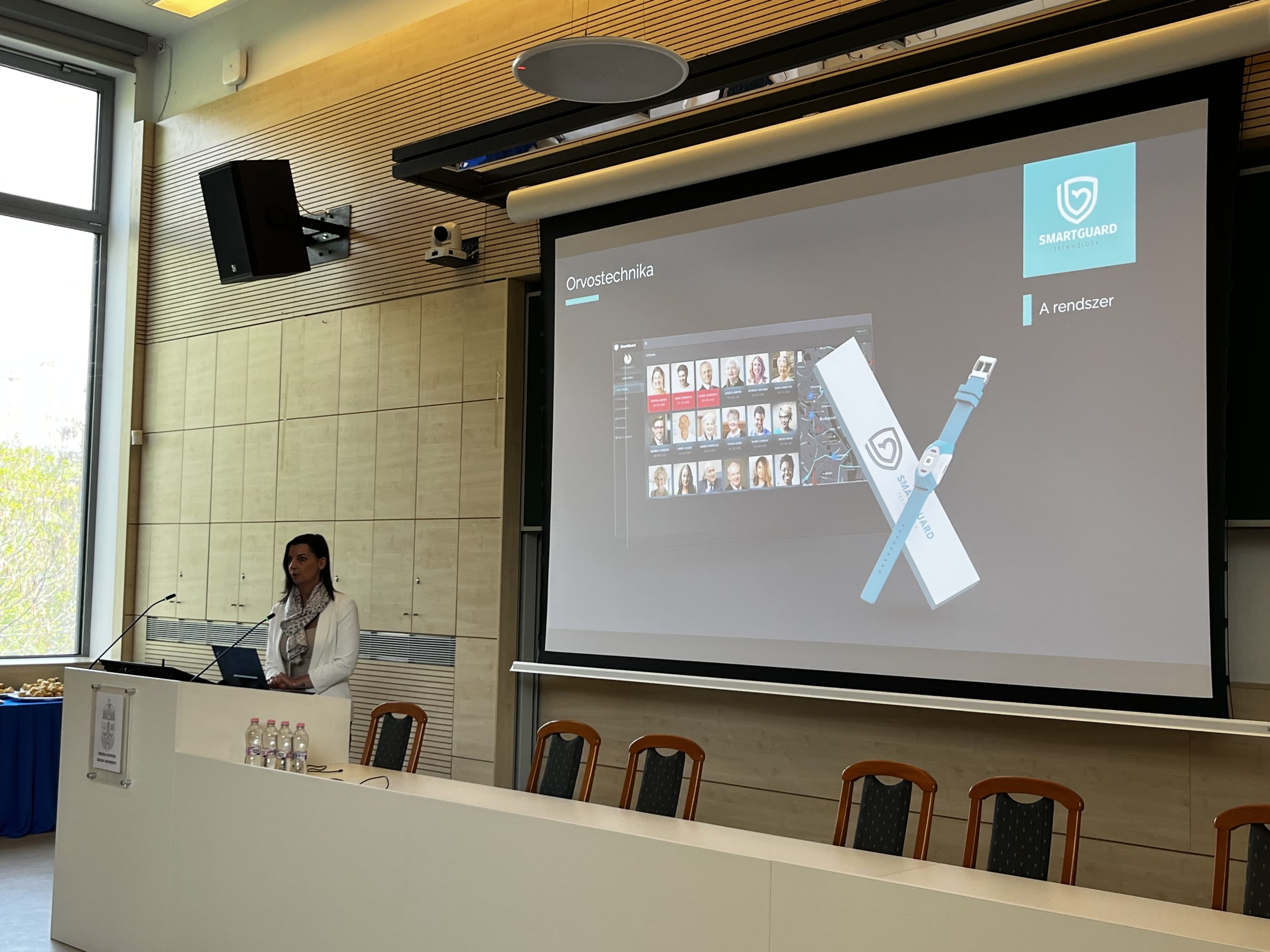
At the Cooperation Open Day of Óbuda University, Smart Guard Technology had the chance to present its work and innovations.
The goal of the event was to bring innovative companies and the next generation of professionals together, so they could meet directly and have real, meaningful conversations about the industry. The university invited several forward-thinking companies, which gave students the opportunity to meet developers and engineers who not only share theoretical knowledge, but also offer real, hands-on experience. For Smart Guard Technology, it is especially important to involve young talents in projects where they can gain practical skills while also contributing to real innovation.
We truly believe in young people. Our goal is that the next generation doesn’t just learn a profession, but also experiences how collaboration works in real life, understands the innovation process, and can become an active part of shaping future technology solutions.
We were invited as guests on the SAASCO MEDbeszéljük podcast, where we discussed the development journey and evolution of the Smart Guard wearable medical technology system.
During the conversation, we looked back at how the system has changed compared to its original concept. Although the product has undergone significant technological and functional development over the years, its core focus has remained the same: delivering reliable, clinical-grade ECG measurement.
Today, Smart Guard is a complex health monitoring system that, in addition to ECG, also includes PPG and EDA based measurements and activity tracking. This allows it to go beyond a single physiological signal and provide a more comprehensive picture of the user’s overall condition.
We highlighted that the system is not simply a data collection device, but an intelligent platform capable of advanced signal processing and analysis, supported by a sophisticated software environment and a webbased interface that enables clinical evaluation and long-term monitoring.
It was also important to emphasize that Smart Guard is not a traditional smartwatch, but a wrist-worn medical device specifically designed for professional and clinical use.
We also discussed the name change and product evolution, which clearly reflects how the original idea has developed into a complex, intelligent monitoring system, supported by backend analytics that assist medical decision-making.
Thanks to the invitation from SAASCO MEDbeszéljük, we had the opportunity to present how an innovative concept evolves into a real, functional medical technology solution, at the intersection of development, clinical thinking, and engineering.
In 2024 September, Smart Guard Technology reached an important milestone by formalizing its collaboration with Óbuda University, strengthening the scientific basis of its ongoing research and development activities.
In the field of medical technology, innovation cannot rely solely on internal engineering efforts. The development of clinically relevant devices requires structured validation processes that extend beyond laboratory environments. Academic partnerships play a central role in this context, providing access to controlled research settings, methodological expertise, and independent evaluation frameworks.
For wearable ECG systems in particular, collaboration with academic institutions enables a level of rigor that is essential for both technical validation and future regulatory acceptance. Through such partnerships, it becomes possible to systematically assess signal quality, ensure measurement repeatability, and interpret physiological data within a scientifically grounded framework. These aspects are critical when transitioning from prototype-level performance to clinically meaningful results.
Beyond technical validation, academic collaboration also supports the broader development process. It facilitates the involvement of human subjects under controlled conditions, contributes to the documentation and transparency of results, and creates opportunities for dissemination through scientific channels. This not only strengthens the credibility of the technology but also aligns development with the expectations of the medical and regulatory communities.
The cooperation with Óbuda University reflects a deliberate approach to integrating scientific validation into the core of product development. Rather than treating validation as a final step, it becomes an ongoing process embedded within the development lifecycle. This approach is particularly important in the context of wearable medical devices, where performance must be demonstrated not only in theory, but under realistic usage conditions.
By building on academic collaboration, Smart Guard reinforces both the reliability and the credibility of its technology, laying the groundwork for future clinical validation and regulatory progression.
We use cookies to ensure that we give you the best experience on our website. If you continue to use this site we will assume that you are happy with it.